


Global logistics represents 20% of the world’s GDP, yet 80% of warehouses lack any automation – not even a conveyor belt. Compounding this are ever-increasing e-commerce demand, an aging workforce & labor shortages (+1M unfilled positions in the US). As such, the logistics industry is ripe for modernization – powered by AI & robotics.
Driven by a philosophy of “what tasks should robots do to make work better for people?” (vs. “what job could the robot do?”), Robust.AI designs for the broader challenge of making human-robot collaborations efficient, effective & engaging while delivering significant ROI.
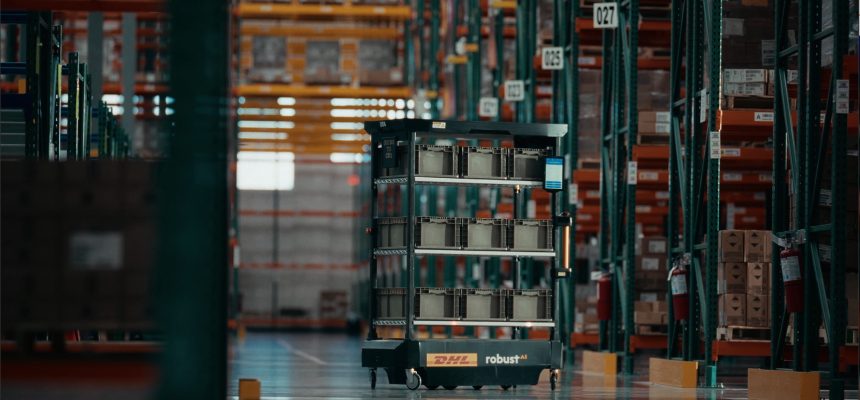
The company’s flagship Carter is a multi-functional collaborative robot that augments existing workforces – vs. replacing them – by combining complementary strengths of both to perform better together than either could perform on their own. This makes workers feel empowered, valued & in control of their work environment, leading to improved performance, job satisfaction & retention. It also presents a clear model of how humans and robots can work together, setting the stage for future collaborations in industries such as hospitality, healthcare, retail, and more.
Three main innovations set Carter apart:
Carter’s software-defined functionality delivers the capabilities of three robots on one platform, serving as a fulfillment picking robot, a point-to-point transport system, or a mobile sorting wall. This provides unprecedented flexibility and enables customers to easily adapt to changing needs & workflows without additional infrastructure costs.
The second innovation is its whole-robot force sensing (haptics) capabilities. Grabbing Carter’s handlebar instantly transfers control to workers, while its patented holonomic drive lets them effortlessly move Carter in any direction with one hand. Releasing the handlebar returns Carter to autonomous mode & sends it to its next destination. This gives workers a greater sense of collaboration, safety, and control.
The third innovation is its 360°, AI-optimized computer vision system and simultaneous localization and mapping (vSLAM) technology for intelligent navigation & improved safety. Although LiDAR technologies can also sense objects and compare them against a database for improved mapping and navigation, Carter’s AI-powered optical sensors help it recognize objects and understand its environment better for improved navigation, safety, learning, and workflow optimization.
In addition to its multi-modal sensing capabilities (i.e., computer vision + haptics), Carter also features multi-modal interaction capabilities. From its intuitive touchscreen UI and built-in barcode scanners, to its adaptive LED system that illuminates the exact bin where picked products belong, to alert sounds and interactive marquee displays, Carter helps workers minimize errors while improving productivity and safety. The company is currently piloting gesture-based commands that will deepen the interactivity between workers and Carter.
The input from Carter’s multi-modal sensing and interaction capabilities turn into data that helps train Carter’s ML models, enabling it to learn faster and perform better. Carter units can also collaborate with each other, allowing one person to manipulate or manage a whole train of Carters instead of just one pushcart at a time.
After implementing Carter, DHL experienced 60% productivity gains in its first weeks. According to Sally Miller, DHL’s North America CIO & DSC Digital Transformation Officer:
“At DHL Supply Chain, we’re constantly pushing the boundaries of what’s possible in logistics. Partnering with Robust.AI allows us to continue redefining what’s possible within the four walls of the warehouse…[and] create a smarter, safer, more reliable supply chain one intelligent robot at a time… [Robust.AI’s] innovative technology exemplifies the strides we are making together in revolutionizing supply chain operations… [and] underscores our commitment to leveraging flexible solutions that drive efficiency and improve the working environment for our associates.”
Due to this success, DHL has expanded the deployment of Carter robots to its Mexico City facility, a growing location of strategic importance that strengthens DHL’s operations and capabilities in Latin America. In addition to DHL, Carter has been deployed by a global semiconductor manufacturer and a large, ecommerce-focused third-party logistics provider.