

There is a deceptively simple question sitting at the heart of every boardroom conversation about artificial intelligence right now: is your company using AI, or is AI part of how your company works? The distinction sounds philosophical, but it is increasingly the difference between AI-native disruptors that are gaining structural competitive advantages, and those that are spending significant budgets to accelerate yesterday’s processes and support legacy structures.
The World Economic Forum put it plainly at its January 2026 Annual Meeting: most companies use AI to cut costs or improve productivity, but the real winners design AI-native business models in which the technology changes how value is created, priced, and captured. That is a fundamentally different ambition, and it requires a fundamentally different organizational architecture.
Where We Are Today
The global AI market has already separated into three distinct tiers. Research from The Branx characterizes them as:
- AI-Core companies (the roughly 5% building foundational models and infrastructure),
- AI-Native companies (approximately 25% where AI is inseparable from the product),
- AI-Enabled companies (the remaining 70% that are layering AI onto existing operations).
That last category is where most large, established businesses currently sit, and it is where the tension is most acute.
The performance gap between tiers is becoming measurable. Generative AI reliably delivers task-level productivity gains of between 15% and 40% when a knowledge worker uses it to draft an email or write code. Those are real improvements. But as WEF research makes clear, they do not automatically translate into company-level earnings. The productivity gain stays trapped inside the old workflow. The structural advantage only emerges when companies redesign workflows around AI rather than insert AI into existing ones.
What makes this particularly challenging for established organizations is the legacy burden. A 2026 Thinking Company report found that 68% of energy executives cite legacy operational technology systems as their primary barrier to AI deployment, and the sentiment echoes across sectors. Infrastructure built before the internet era was not designed for real-time machine learning. Systems written in COBOL, databases that predate APIs, and operational processes hardened over decades of regulatory compliance do not accommodate agentic AI without costly, time-consuming and frequently political rebuilding.
Meanwhile, a new kind of scarcity is emerging. The WEF argues that as AI absorbs more execution, the marginal cost of doing work collapses. The scarce resource shifts from doing the work to subject-matter experts capable of directing, governing, and improving the work. The bottleneck is no longer processing power or software capability. It is human judgment, applied at the right moment.
What Companies Are Experimenting With
Fintech: The Most Vivid Case Study
Few sectors illustrate the AI-native divide more acutely than financial services, because the legacy burden is so visible and so costly to overcome. The architecture of traditional banking relies on core systems designed in the 1970s and 1980s, with regulatory layers added over decades, and data siloed across business units that have never been integrated. It represents a structural disadvantage that no amount of AI layering can fully resolve.
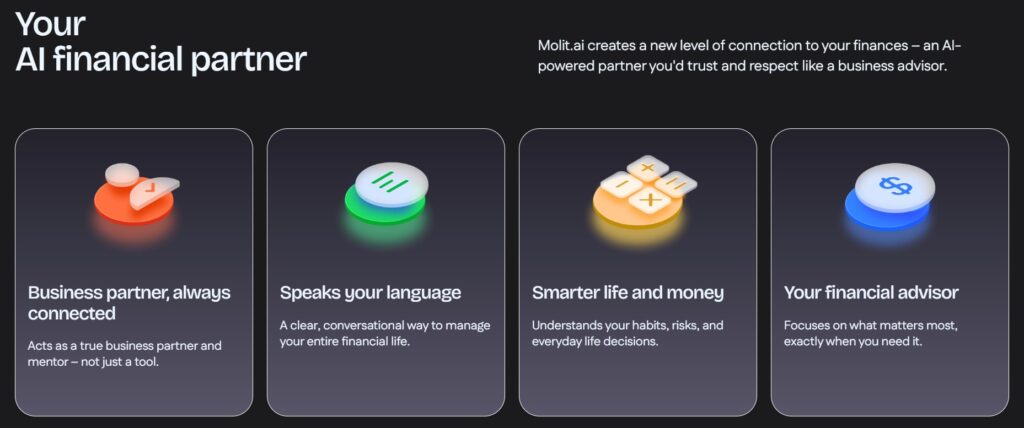
AI-native disruptors are building very differently. Molit.ai, a European bank under development by serial entrepreneur and investor Dmitry Volkov, treats the bank itself as a technology-native system, where intelligence is embedded into the core architecture rather than added on top. The contrast with incumbents is intentional and precise. Traditional fintech adds features; Molit.ai frames banking as a daily partnership with AI.
On the infrastructure side, platforms like Mambu, Thought Machine, and 10x Banking are replacing monolithic banking cores with modular, cloud-native systems that are API-first, event-driven, and capable of supporting real-time deposits and dynamic credit products. With legacy systems, launching a new product can take months or longer. Modern stacks can ship new features in days, with full audit trails and sandboxed testing environments. That is not an incremental improvement. It is a different order of competitive speed.
 Klarna is the most cited proof point of AI-native advantage at scale. The company is already deflecting 66% of customer service interactions via AI, a figure that would be impossible on legacy infrastructure. Platforms like Klarna’s “Money Story” and Curve’s Smart Rules optimize spending and savings in real time, and analysts estimate that if 10 to 20% of consumers adopt agent-driven cash management, bank net-interest margins could tighten by 30 to 50 basis points industry-wide.
Energy: Forced Transformation
The energy sector presents an equally compelling contrast, compounded by the unique and urgent pressure of surging AI-driven electricity demand. For the first time in two decades, electricity demand is rising sharply, largely because of data center growth. Demand is expected to increase by more than 30% over the next decade, yet the current grid infrastructure was never designed for that transition. Average US electricity prices have increased 5% in a single year, with some states seeing rises of over 20%.
The structural problem for incumbent utilities is well documented. About 72% of utility innovation leaders admit that in-house innovation is primarily driven by regulation or compliance, and just a quarter say they regularly draw on ideas from startups. That is not cultural timidity. It reflects the reality of operating critical infrastructure under regulatory frameworks that reward predictability and punish failure.
AI-native energy startups are filling the gap with remarkable speed. GridCARE, a Stanford-born startup, completed a project with Portland General Electric in Oregon that freed up 80 megawatts of incremental capacity for new data centre load, using its generative AI methodology to identify hidden flexibility in existing infrastructure and help the utility interconnect multiple data centres years earlier than would otherwise have been possible.
NextNRG’s AI-powered platform connects on-site mobile fuel delivery, wireless EV charging, utility orchestration, and microgrids, predicting solar energy production and switching to the cheapest available power source dynamically. The company reported 139% year-on-year revenue growth in early 2025.
 Even large incumbents confirm the timeline penalty of legacy systems. Enel’s AI transformation journey illustrates the gap: foundation work from 2021 to 2022, operational proof-of-concept from 2023 to 2024, scaling across 120-plus facilities through 2025, and full AI-native operations only targeted for 2027.
The programme generated €340 million in cumulative avoided downtime costs through phase three, but the timeline alone reveals why AI-native startups can move so much faster.
Retail: Personalization at Scale
Retail is where AI’s potential for transforming customer experience is perhaps most tangible, and where the gap between AI-native approaches and legacy deployment is playing out in real time in front of consumers.
Amazon’s recommendation engine remains the canonical example: built on collaborative filtering and neural networks, it now accounts for over 35% of the company’s revenue. That is not AI as a feature. It is AI as revenue architecture.
Walmart’s generative AI-powered search engine delivers hyper-personalized product recommendations by analyzing user behaviour, family shopping patterns, and regional demand simultaneously, driving 22% e-commerce growth in Q1 2025. Its AI-driven logistics systems are saving $75 million annually in delivery optimization alone.
 ZARA’s parent company Inditex offers a compelling example of AI being embedded into production itself, not just the customer interface. ZARA uses AI to analyze real-time demand signals and adjust design, manufacturing, and restocking within weeks rather than months, reducing unsold inventory by 13% year over year, according to Inditex’s own earnings report.
Its AI also tracks customer traffic patterns in-store to dynamically reposition high-demand products. Overstock reduction reached 20% through its “Just-Intelligent” supply chain programme, while fabric waste fell by 15% and production turnaround times collapsed to one week.
As of 2025, 87% of retailers report that AI has had a positive impact on revenue. 94% say it has reduced operating costs, according to data compiled by Shopify. The holdouts are not skeptics so much as organizations caught in the same legacy infrastructure trap that constrains utilities and banks: fragmented data, siloed systems, and the compounding cost of deferring decisions that grow harder each year.
What This Means for Marketing Teams
Marketing is one of the functions where the AI-native shift is most disruptive to existing team structures, partly because the tools are visible and accessible, and partly because the gap between what AI makes possible and what most organizations are actually doing is so stark.
Although 75% of marketers have adopted AI, Salesforce’s latest State of Marketing report found that 84% are still running generic campaigns. The report’s summary is blunt: “We are using the most powerful technology in history to send more one-way spam, faster.” The culprit is not lack of effort. Only 58% of marketers have complete access to service data, 56% to sales data, and just 51% to commerce data. Siloed systems are preventing AI from doing the thing it does best: joining dots that humans cannot.
The organizations closing this gap are doing so by moving from AI tools to agentic AI systems. An agentic AI marketer identifies opportunities, launches campaigns, personalizes outreach, and optimizes results autonomously, acting more like a digital team member than software. Early adopters report conversion rates seven times higher than traditional outbound approaches, alongside faster campaign execution and stronger alignment between marketing and sales.
The structural implications for teams are significant, and roles are changing. Marketing managers are evolving into AI workflow architects, content creators into brand voice strategists, and analysts into insight interpreters who guide AI decision-making rather than manually processing data.
This reshaping of roles is explored in depth in our blog on Building Effective AI-Human Partnerships in Collaboration, and it is consistent with what forward-thinking CMOs across sectors are reporting: the job is not disappearing, but it is changing faster than training programmes can keep up.
Agentic systems are beginning to take on full campaign lifecycles, from strategy through to optimization, negotiating media buys machine-to-machine and delivering performance adjustments in real time. Zeta’s “Athena” platform and similar tools represent a preview of what becomes standard within two to three years: marketing intelligence that is continuous, conversational, and increasingly autonomous, with human oversight focused on strategy, brand judgment, and governance.
The content creation dimension of this shift is already transforming supply chains for creative agencies, as AI tools enable lean teams to produce work at agency scale. The more important transformation is happening inside marketing departments themselves, where the question is shifting from “how do we produce more content?” to “how do we govern an AI system that produces content on our behalf?” That is a fundamentally different management challenge, and most organizations are not yet equipped for it.
Data governance is central to the answer. Adobe’s 2025 AI and Digital Trends report found that 45% of consumers say visibility and control over their data is a top priority when engaging with brands. As personalization becomes more precise and more autonomous, the accountability question sharpens. Who is responsible when an AI system makes a targeting decision that turns out to be discriminatory, inaccurate, or simply wrong? The answer cannot be “the model.”
What the Next Two to Three Years Will Bring
The trajectory is reasonably clear, even if the exact timing is not. By 2030, AI-native public companies will share common characteristics: flatter structures, expertise-driven operating models, real-time decision-making, and software that behaves like a living system rather than one requiring periodic upgrades. The companies that get there first will not be those that spent the most on AI tools. They will be those that redesigned their organizations around AI’s actual capabilities.
The workforce implications are substantial and will affect every function. A 10 to 20% reduction in traditional middle-management positions is expected by end of 2026, concentrated in roles built around information routing, coordination, and document summarization. Companies with more than 5,000 employees will be particularly affected as reporting-heavy roles in finance, compliance, supply chain planning, and procurement shift to AI-native workflows.
This is not a prediction about distant futures. AI-native departments are already being defined as functions where 40 to 60% of day-to-day activities are executed autonomously, with humans stepping in for interpretation, escalation, and relationship-sensitive decisions.
The engineering discipline of “context engineering” will emerge as a distinct organizational capability. Doruk Mutlu, CEO of Evam, explored this aspect at the Tech.eu Summit 2026. AI is trained on so much historic data that developing its potential to look forward can be overlooked. “AI gives everyone the same tools. Context is the new competitive arena,” he told the audience in London, UK.
By mid-2026, dedicated teams and specialized infrastructure will be needed to serve AI agents the minimal but complete information they require to make good decisions. The battleground will shift from owning raw data to owning its interpretation, and the semantic layer will become as important as the database was to analytics a generation ago.
For startups and new market entrants, the structural advantage remains durable. AI-native disruptors have inherent advantages. They do not have to overcome legacy systems, data debt accumulated over a decade, or the political weight of one-off integrations that nobody wants to retire. They can design clean schemas, transparent logic, and agent entry points from day one. In established organizations, changes run through committees and cannot be tested at the same speed.
This is the lesson fintech demonstrated for banking, and that energy startups are now demonstrating for utilities. It is a lesson that will play out in sector after sector as the pace of AI-native competition increases.
By the end of 2026, at least 50 AI-native businesses are expected to reach $250 million in annual recurring revenue, with several poised to cross the $1 billion mark. The velocity of this growth has no precedent in enterprise software, and it is being driven not by the foundational AI companies but by the sector-specific applications that are solving real operational problems for specific industries with no legacy overhead to carry.
The organizations most worth watching in the next three years will not necessarily be the largest or the best-resourced. They will be the ones who first understood that the question was never about what AI tools to buy. It was always about what kind of company to become. This is precisely the spirit that BOLD Awards exists to recognize: bold, purposeful digital innovation that reshapes industries rather than merely improving on what existed before.
You can explore examples of how this thinking is already being applied in our blogs on Digital Payments Powering the Innovation Economy and AI Tools For Creators Shaping New Marketing Playbooks.
The AI-native company is not a future concept. It is already a competitive reality, and the distance between those inside it and those watching from outside grows a little wider every quarter.