
Many VCs focus on specific industry sectors to help them achieve some standout in the crowded marketplace. It allows them to focus their knowledge and expertise, concentrate on making the right contacts and connections, and build influence. Some even encourage collaboration between the businesses they invest in, for the mutual benefit of everyone involved. Others may focus on the development stage startups have reached, such as from seed stage to series A or B. Some may concentrate on geographical areas, or developing economies. Here, we highlight ten VCs that stand out from the crowd due to the unique ways they position themselves in the marketplace.
Market background in H1 2025
Venture capital (VC) investing in 2025 has been characterized by a strong but uneven recovery, building on the rebound from the 2022-2023 downturn. Globally, H1 2025 (January-June) saw approximately $217 billion in total funding across around 13,500 deals, marking the strongest half-year since H1 2022. Compared to 2024’s full-year total of around $285 billion (a recovery year post-2022 lows), 2025’s H1 pace suggests a potential annual figure of $350-400 billion if trends hold,
Key drivers include advancements in AI, a tentative IPO market revival (e.g., CoreWeave’s $1.5 billion initial public offering), and rising M&A activity (mergers and acquisitions), which hit $100 billion in H1 (up 155% YoY). However, investor caution remains above average amid high valuations, geopolitical tensions (e.g., US tariffs, trade wars, actual wars), and delayed liquidity events. The rapidly growing AI sector is sucking in VC money, particularly in the U.S., and several other industry sectors are in fact showing a decrease.
Some of the decrease is due to investor hesitation while they look to see how industry sectors are integrating AI into their businesses. To invest with more commitment, the market needs to build a playbook of how to incorporate AI in order to judge who’s getting it right and who isn’t. Sectors with low overall AI take-up are faring the worst.
U.S. VC Activity in H1 2025 by Industry Sector
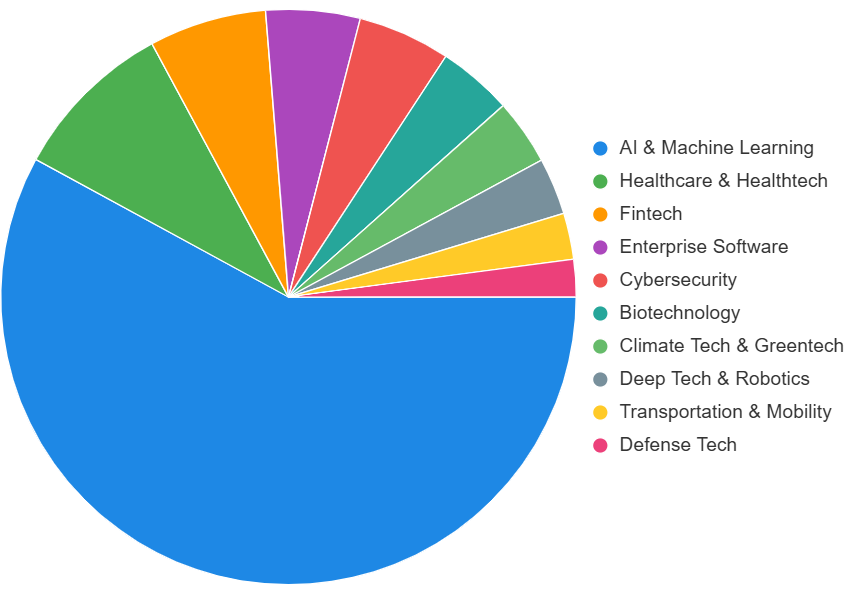
AI and Machine Learning startups accounted for 58% of VC investments in the first half of 2025 in the U.S. The second most invested sector was Healthcare and Healthtech, followed by Fintech. Between them, the three sectors secured 74.8% of the total U.S. VC investment in the first half of 2025.
VC activity by Industry Sector in H1 2025 in Europe and the UK
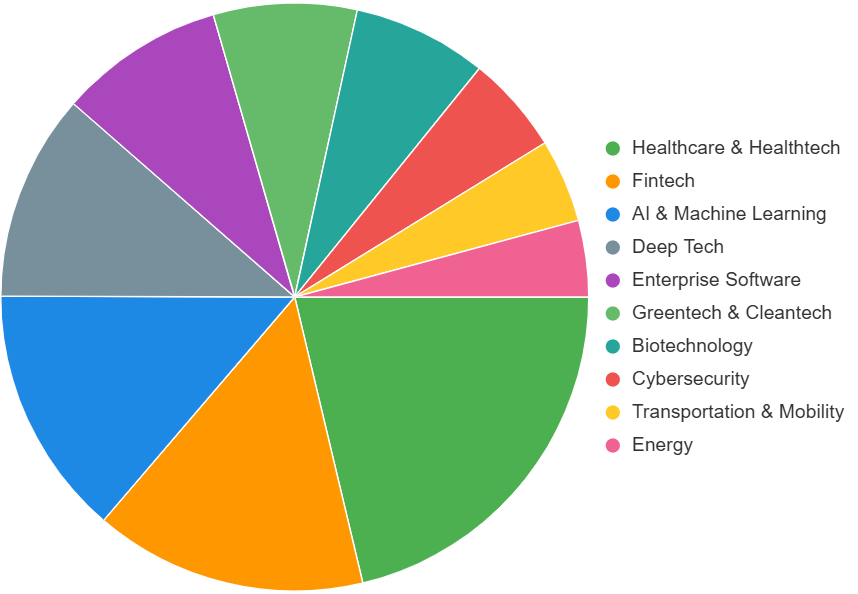
In Europe and the UK combined, the sector receiving the largest VC investment was Healthcare and Healthtech. This reflects the increased market potential due to an aging population that is also living longer, and a focus on tech solutions due to a general shortage of qualified workers. The Fintech sector was second, and AI and Machine Learning was in third place. These same top three sectors as in the U.S. accounted for an estimated 50.1% of all VC investments across Europe and the UK.
VC specialisation for unique standout in the U.S.
Several U.S.-based venture capital firms stand out for their unique investment criteria or processes, which often differentiate them in a competitive landscape. These include unconventional structures for decision-making, transparency tools, geographic or thematic focuses, and hands-on support models that go beyond traditional diligence.
Decile Group’s VC Lab
VC Lab was launched in early 2020 by the San Francisco-based Decile Group. Decile Group itself was established around the same period, with an aim to address barriers in the VC industry such as high entry costs for new managers and lack of support for underrepresented founders and GPs (general partners).
Its mission is to accelerate the launch of new VC funds, particularly for first-time or emerging managers (e.g., solo GPs, female-led funds, underrepresented groups, or those targeting niche themes like social impact, immigrant founders, or emerging tech). In doing so, VC Lab operates as a “VC for VCs.”
It emphasizes small fund sizes (often $1-10M to start), and institutional-grade operations without the traditional barriers of high legal or operational costs. It is also a flag-bearer for ethical investing through its Mensarius Oath. This is an ethical code that all participants must agree to, emphasizing transparency, societal impact, and avoiding predatory practices.
In addition to funding, VC Lab provides 16-week accelerator courses, running multiple times a year. The courses provide emerging VC fund managers with training on fund formation, pitching, deal sourcing and operations. It organises networking events for the managers to meet VC Lab’s 600+ alumni, plus other potential sources of capital. Premium packages provide one-on-one mentorship and a fast-track to funding.
Bessemer Venture Partners, San Francisco
Maintains an “Anti-Portfolio” publicly listing declined investments (e.g., early passes on Google and Coinbase) to promote transparency and learning; offers startup resources like an AI chatbot for scaling advice, and a comprehensive playbook.
This approach fosters trust and self-reflection, appealing to founders in SaaS, cybersecurity, and healthcare; in 2025, it emphasizes AI-driven tools for due diligence.
Benchmark, San Francisco
Employs a flat partnership structure with only 6-7 partners sharing equal profits and decision-making, enabling fast, consensus-based investments without hierarchy.
Focuses on early-stage tech; the egalitarian model reduces bureaucracy, making it ideal for high-conviction bets in 2025’s selective market.
Founders Fund, San Francisco
Prioritizes contrarian, intellectually diverse ideas with a flat structure where all partners equally influence decisions; avoids “me-too” investments in favor of bold, paradigm-shifting tech.
Backed by Peter Thiel; in 2025, it targets space, defense, and AI with a process that values founder vision over metrics.
Drive Capital, Columbus, Ohio
Stage-agnostic investments exclusively in tech companies outside Silicon Valley (east of the Rockies to west of the Hudson), emphasizing regional ecosystems, high ownership stakes, and realistic exits (c.$3B scale) over unicorn hunting.
Supports enterprise, AI, and robotics in the Midwest/South; unique for decentralizing VC from coasts, aligning with 2025’s push for diverse U.S. innovation hubs.
Khosla Ventures, Menlo Park, California
Founded by Vinod Khosla. In 2025, it balances deep tech (e.g., AI, biotech) with climate, requiring founders to demonstrate bold, world-changing potential.
It targets “unconventional” early-stage ideas with a dedicated $1B Green Fund for sustainability and cleantech; uses a thesis-driven process assessing long-term societal impact alongside tech feasibility.
Andreessen Horowitz, Menlo Park, California
Sources deals via its partners’ personal angel networks. It builds a full “platform” for portfolio companies, including talent recruitment, policy advocacy, and content like podcasts for thought leadership.
Manages $46B+; unique ecosystem in 2025 supports AI, crypto, and bio/health, with a process that integrates media for founder visibility.
VC specialisation for unique standout in Europe and UK
Several venture capital firms in the UK and Europe distinguish themselves through innovative investment criteria or processes, such as hands-on operational involvement, regional decentralization, founder-centric networks, or specialized support ecosystems. Here are three.
High-Tech Gründerfonds, Germany
Government-backed seed specialist with a flexible co-investment process: invests up to €1M initially (scaling to €4M total), leveraging a vast network to syndicate follow-ons; criteria target innovative German-headquartered tech under 3 years old in industrial/digital/life sciences.
It is Europe’s largest early-stage fund for deep tech like AI, robotics, and biotech. Its public-private model uniquely bridges R&D gaps, supporting long-runway innovations with low-barrier entry for founders in a risk-averse market.
Speedinvest, Austria
Delivers “game-changing” support from day one, including full access to operational experts, industry networks, and aligned incentives for pre-seed/seed; process defines “seed” flexibly, emphasizing actionable scaling over rigid stages.
Pan-European early-stage fund targeting deep tech, AI, and fintech, with offices in Vienna, London, Berlin, Munich, and Paris. It stands out for empowering technical founders with global resources, and for investing €500K-€5M to build category leaders amid Europe’s fragmented ecosystems.
Seedcamp, London, UK
Founder-first philosophy with a lifelong support network. Seedcamp invests in pre-seed/seed stages for world-class founders targeting global markets, providing instant access to mentors, capital, and a collaborative community rather than siloed advice.
It is Europe’s pioneering seed fund, backing tech-driven startups in fintech, SaaS, and marketplaces; it emphasizes scalable, tech-forward ideas with investments of £300K-£500K, fostering a “Seedcamp Network” for ongoing collaboration.
These firms are examples that highlight Europe’s evolving VC scene in 2025, where uniqueness often lies in bridging funding with ecosystem-building, regional focus, or accelerated support to compete globally.
Which other VCs deserve to be mentioned here due to their unique marketplace positioning or investment criteria? Let us know, and we’ll create an extra section.
BOLD Awards 2026
Our annual awards highlight and celebrate innovations and breakthroughs achieved among a global community of digital industry leaders. Entering BOLD Awards VII isn’t just a flex—it’s a launchpad to outshine competitors and dominate your sector.
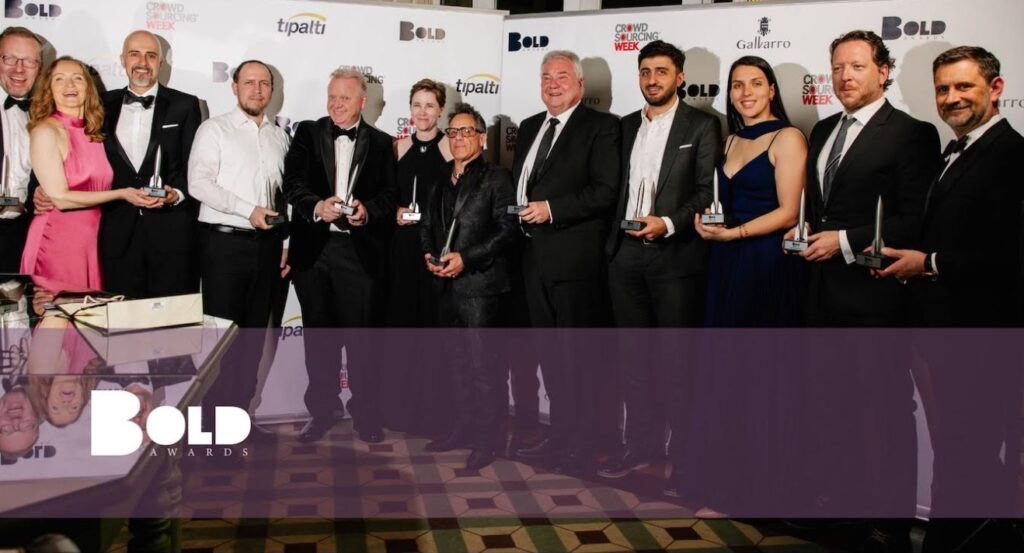
The BOLD Awards VI gala dinner ceremony took place in March 2025, in Lisbon, Portugal. Prizes were awarded in 21 categories of digital industries and the technology that powers them. Full details of the winners are just a click away.
BOLD Awards VII is now open for entries, at an Earlybird processing fee of just €49. Entries can be revisited and upgraded at any time up to the final deadline in December 2025, even after the Earlybird period closes. Judging will begin with a round of public voting in January 2026, and continue with assessments by an international panel of judges, leading to a glittering award ceremony for all finalists on 27th March 2026 in Barcelona, Spain.
There are also opportunities to gain prominence and prestige as a category sponsor. Send an email to hello@bold-awards.com for more information about this.