

Stablecoins are cryptocurrencies designed to maintain a stable value, typically pegged to fiat currencies like the USD, to provide a reliable medium of exchange in the volatile crypto market. This article reviews the latest trends, though crypto remains far from straightforward, even when pegged to fiat currency. What lessons should be learned from the 2022 collapse of Terraform Labs in Singapore, which wiped out an estimated half a trillion USD from the crypto market? And what progress is being made by central banks to develop their own digital currencies (CBDCs)? Read on.
Top 5 Stablecoins
Based on the latest data from sources like CoinMarketCap, CoinGecko, and DefiLlama (as of mid-September 2025), the total stablecoin market capitalization stands at approximately $289-293 billion. The top five stablecoins, USDT, USDC, DAI, USDe, and USD1, account for roughly 90% of the total market cap.
The stablecoin sector has grown ~6% month-over-month, driven by regulatory clarity (e.g., U.S. bills for stablecoin oversight) and integration into traditional finance. Tether (USDT) and USDCoin (USDC) alone represent over 80% of the total market, but newer entrants like USD1 are shaking up rankings amid DeFi and political influences.
The figures given are approximate, and can fluctuate rapidly due to market dynamics. We have used the most recent aggregated estimates (research conducted in September 2025) from reliable crypto trackers.
Tether, USDT
The market leader by a big margin, with a capitalization of an estimated $170 billion. It is the original and largest stablecoin, launched in 2014 and pegged 1:1 to the USD. It is based in the Caribbean, and dominates the sector with over 58% total market share.
Most stablecoins underpin their value by holding U.S. cash reserves and U.S. Treasuries, which are debt securities issued by the U.S. government. Tether, on the other hand, has diversified away from relying on the U.S. financial system. It claims to own over 100,000 Bitcoins, 50 tons of gold, and 70% of a major agricultural group that operates 210,000 hectares of farmland in South America. The land produces crops, dairy and bioenergy, providing sales income as well as appreciating as an asset. The USDT is thus supported by a hybrid model of crypto and traditional asset investments.
USDCoin, USDC
Its current market capitalization is estimated at $61-$64 billion. Issued by Circle and Coinbase, USDC is fully backed by USD reserves and audited regularly. It gained traction in 2025 with institutional adoption and integration into payment networks like Visa. Nearing $64B supply amid rising demand.
Dai, DAI
This decentralized, crypto-collateralized stablecoin from MakerDAO (launched 2017) has a current market capitalization of $5.4 billion. Over-collateralized by Ethereum and other assets, it is known for its algorithmic stability mechanism and high daily trading volume (~$20B).
Ethena USDe, USDe
A synthetic stablecoin using delta-hedging strategies with Ethereum derivatives, with an estimated market capitalization at September 2025 of around $3-$4 billion. It has gained popularity in DeFi but faced regulatory scrutiny in 2025 over backing reserves. Part of the growing algorithmic/synthetic segment.
ESD1 (World Liberty Financial), USD1
This newcomer to the Top 5 Stablecoins was launched in 2025 by World Liberty Financial, which is associated with U.S. President Trump and his family. A DeFi-focused stablecoin pegged to the USD, its market capitalization of an estimated $2-$3 billion is rising rapidly due to political ties and new stablecoin legislation such as the Genius Act.
Market Share among the Top 5 Stablecoins
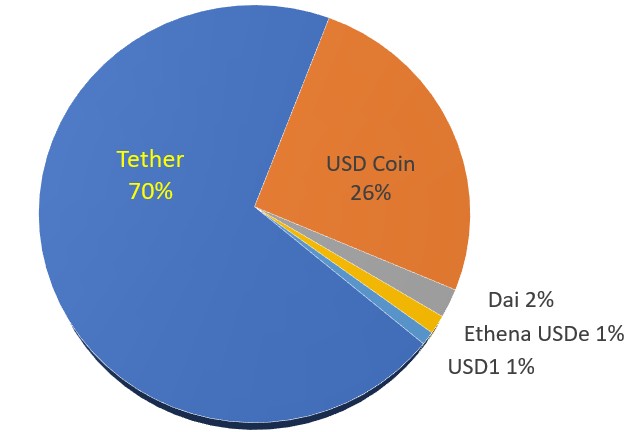
It will be interesting to see if the top 5 stablecoins can maintain their current positions during the next 12 months, a period in which the Genius Act is likely to attract new non-bank entrants. This could include tech companies and retail giants, because stablecoins represent a possible way to reduce credit card transaction fees, explained a Nasdaq blog in June 2025: “Tether and USDC are almost certain to hold on to their top positions, but there’s a lot of room for innovation and disruption in the 10% of the stablecoin market that they [the current top 5] currently do not control.”
What should be learned from the collapse of Terraform Labs?
Terraform Labs was founded in 2018 to use blockchain technology that aimed to create a decentralized finance network. The blockchain used TerraUSD (UST) and its sister token, Luna, to create an algorithmic stablecoin system. Algorithmic stablecoins like UST use complex incentives to maintain their value, unlike stablecoins backed by fiat currency. When UST’s price dropped below $1, traders could exchange it for $1 worth of Luna, reducing UST’s supply and boosting its price. Conversely, when UST’s price exceeded $1, users could trade $1 of Luna for newly minted UST, increasing supply and decreasing price. However, this mechanism relied on Luna’s price remaining high, which was severely tested during the market turmoil of 2022
UST lost its dollar peg. As investors rushed to redeem UST for Luna, the circulating supply of Luna surged, leading to a catastrophic 99% plunge in its value. This collapse of Luna’s collateral value triggered a vicious cycle of selling pressure, rendering UST’s peg untenable. Both Luna and UST plummeted to near worthlessness, wiping out a staggering $40 billion in market capitalization in just seven days.
The devastating outcome left the Terra community in financial shambles. Despite attempts to rebrand and revamp their offerings, the Terra Luna ecosystem, including its UST logarithmic stablecoin, has failed to bounce back. So, what are the lessons?
Key Lessons for the Stablecoin Marketplace
- Move Beyond Purely Algorithmic Models: The UST collapse proved that algorithmic stablecoins, which rely on complex tokenomics and arbitrage for stability, are highly vulnerable to market stress and “death spirals”. Algorithms keep their prices stable by balancing funds held on the blockchain using smart contracts to control supply and demand and maintain price stability. A shift towards more reliable models with substantial collateral backing, or at least hybrid models, is necessary.
- Prioritize Transparency and Robust Reserves: UST’s failure was exacerbated by a lack of transparency and insufficient reserves to absorb market shocks. Stablecoins, particularly the 5 largest stablecoins, need to demonstrate clear, verifiable collateral reserves and transparent operational mechanisms to build trust.
- Implement Effective Collateralization and Risk Management: Stablecoins should implement strong collateralization, potentially over-collateralized with assets like Bitcoin or stable fiat-backed assets, and have more comprehensive reserve and liquidity management strategies.
- Address Systemic Risk in DeFi: The Terra collapse created a ripple effect, causing liquidity crunches and panics across the crypto market. This shows that the stability of one stablecoin can significantly impact other interconnected DeFi platforms and markets.
- Enhance Investor Protection and Education: The collapse served as a reminder that many stablecoins and DeFi products are experimental and involve substantial risks, especially for retail investors who may not fully grasp the underlying mechanisms.
- Foster Industry Best Practices and Voluntary Risk Mitigation: The incident highlighted a need for the industry to adopt stricter, voluntary risk management tools and disclosure standards to improve resilience, even in the absence of extensive compulsory regulation.
- Promote More Resilient and Mature Stablecoin Designs: The market needs a balance between innovation and stability. The focus should shift from purely experimental models to more proven, production-ready stablecoin designs that can withstand market volatility and serve as a stable foundation for the digital economy.
Latest Developments in Central Bank Digital Currencies (CBDCs)
Central Bank Digital Currencies are poised to reshape finance while addressing risks like privacy and financial stability. They continue to evolve as a cornerstone of global financial innovation, with central banks worldwide accelerating pilots, launches, and regulatory frameworks to modernize payments, enhance financial inclusion, and strengthen their own control of monetary policy.
As of mid-2025, over 134 countries and currency unions—representing 98% of global GDP—are exploring or developing CBDCs, up from 114 in 2023, according to the Atlantic Council’s CBDC Tracker. This surge reflects a shift from conceptual research to practical implementation, driven by advancements in technology, regulatory clarity, and the need to counter private stablecoins.
While three countries—the Bahamas (Sand Dollar), Jamaica (Jam-Dex), and Nigeria (eNaira)—have fully launched retail CBDCs, 72 nations are now in advanced phases (development, pilot, or launch), with 49 active pilot projects. The global CBDC transaction value is projected to reach $213 billion by year-end, nearly doubling from 2023, amid expanding use cases like cross-border payments and offline functionality.
We will look closer at CBDCs in a follow-up blog.
BOLD Awards VII, 2026
Think your company is shaping the future?
Enter the BOLD Awards for your chance to be celebrated among the boldest, most visionary companies driving change across industries and around the world. There are awards for 22 categories of digital industry, including Boldest Crypto.
The BOLD Awards honours organisations and individuals who take intelligent risks, spark innovation, and make an impact — from startups to global giants. Whether you’re reimagining healthcare, revolutionising AI, or building the future of finance, there’s a category for you.
All entries are reviewed by a global panel of innovation leaders and industry experts. Winners will be celebrated at our flagship gala in Barcelona on March 27, 2026; featured across international media; and showcased to a powerful network of BOLD thinkers and doers.
There are also opportunities to gain prominence and prestige as a category sponsor. Send an email to hello@bold-awards.com for more information about this.