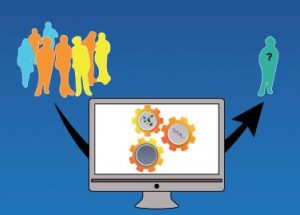

I wonder if the Nobel Prize-winning economist Paul Romer had John Lennon’s words from his song ‘Imagine’ in mind when he developed his ideas about Charter Cities? “Imagine, there’s no countries, it isn’t hard to do.” The blurring, if not removal, of national jurisdictions is central to Romer’s ideas. Their initial core focus was for governments of developing countries to lift millions of people out of poverty by allowing other nation states (or private investors) to build and control cities in their country. These cities would operate under their own autonomous governance and economic systems, attracting investment and fostering innovation. It enables a struggling country to break out of poverty, even if it’s trapped in a system of its own bad rules, said Romer. “Blueprint for a new kind of colonialism,” say critics. Let’s take a look, and help you reach your own opinion.
What is a Charter City?
Whilst it makes sense to build Charter Cities as smart cities, it does not mean smart cities are the same as Charter Cities. Romer’s vision is that Charter Cities are new or redeveloped urban areas granted special jurisdiction to operate under distinct governance, legal, and economic systems, often separate from the host country’s rules. They go beyond special economic zones (SEZs), which focus on economic incentives, because in their aim to drive economic growth and alleviate poverty Charter Cities will operate autonomous ecosystems with their own laws, judiciary, and sometimes immigration policies.
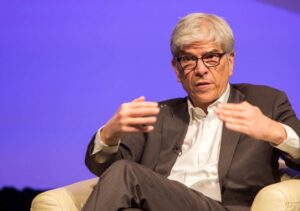
This autonomous governance could be administered by a more developed nation, a private entity or a public-private partnership. Pro-business rules would probably include low taxes and property rights protection. They are designed to attract foreign investment and create jobs, particularly in developing nations. Participation by residents and businesses alike would be on a voluntary basis – people would be “voting with their feet” to take part (as Romer put it in his 2009 TED Talk).
The purpose is to create scalable, high-density urban hubs that foster innovation, lift millions out of poverty, and experiment with governance models. Their relevance in 2025 is that the trend to urbanization is already straining developing economies, and global migration is adding to those pressures. The combined effect sees over 70 million people a year moving to cities. Populist leaders are increasingly being elected to power on anti-immigration tickets, social media echo chambers encourage hardened attitudes, and societies are polarising over this issue.
At scale, Charter Cities may offer a potential solution for sustainable growth. However, sceptics need to be won over. Can Charter Cities fulfil Romer’s utopian dream, or are they simply initiatives for the rich to get richer while the poor are exploited as cheap labour with perhaps even less legal protection?
Próspera, in Honduras
Próspera is a widely acknowledged example of trying to put the Charter Cities theory into practice, though it is a little off the beaten track. It is a gated (but not closed) community of around 1,700 people, created in 2017, living and working at the end of an unmade and un-signposted road on an island.
Contrary to some people’s ideas that Charter Cities are created for a global digital nomad community, 75% of Próspera’s residents are Hondurans. However, many of the nearby local residents outside the development have no idea what it is. They most commonly believe it to be an exclusive holiday resort.
Próspera was established as a U.S. company to operate a privately-owned ZEDE (Zone for Economic Development and Employment), granting it a degree of autonomy from the Honduran government in areas like governance, taxation, and dispute resolution. Investors include Peter Thiel (former CEO of PayPal) and Sam Altman (CEO of OpenAI). Since its creation in 2017 it has been mired in controversy.
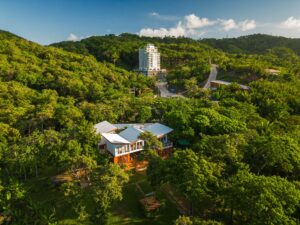
It aimed to attract tech and crypto firms with low taxes and blockchain-based governance. Biotech firms have taken advantage of relaxed regulations covering scientific experiments to explore solutions to challenges including dementia, schizophrenia and neuron reconstruction of brains. One company has been 3D printing human organs developed from stem cells in menstrual blood. Crowdsourcing a steady supply of blood from women who can self-collect it at home in a non-invasive way, plus the relaxed regulations, has accelerated their research programme far beyond what could be achieved in the same time scale in the U.S.
Other on-site tech and facilities include a bitcoin ATM, allowing users to both deposit cash and draw cash from a bitcoin wallet. Incoming supplies to Próspera are delivered by drones.
Residents can elect to have rice-grain-size chip implants as part of a broader biohacking and medical innovation ecosystem aimed at enhancing human capabilities, longevity, and convenience. They enable sensory augmentation, health monitoring, and secure digital transactions. Magnetic implants allow users to detect magnetic fields, potentially aiding in navigation or interaction with electronic devices, creating a “human cyborg” experience. A 2024 biotech conference in Próspera raised $1.5M for startups, with implants facilitating secure access to trial data or funding. As with other medical research, Prospera’s regulations over implants are far more relaxed than the U.S. FDA’s, for example.
In Próspera, residents can buy or incorporate property, and property is linked to political voice. Under current rules, Próspera has an elected nine-person governing council. Physical residents each have a vote for some positions, and property owners, defined as “natural persons or legal entities who are the title owners to at least one square metre of land within Próspera” have additional votes for each square metre of land they own. Does this unduly reward the wealthy? So much for “one man, one vote.”
Supporters point out the work opportunities Próspera has created for 3,000 local off-site Hondurans, who earn significantly higher rates of pay than the national average. There is also a free-to-attend school that teaches local children English and numeracy, on computers.
The crowdsourcing of opinions among Próspera’s residents over how they want to live has been described as GaaS – Governance as a Service. It makes the Charter City a testing ground for competitive/alternative styles of government.
More Charter City Examples
Morazán City
Also in Honduras is another Charter City that was designed specifically for blue collar workers. Some comparisons with Próspera are useful.
Ciudad Morazán is a Honduran ZEDE founded by an Italian businessman named Massimo Mazzone. The urban development plan proposed that the ZEDE and its industrial zone would become home to 9,000 working-class and middle-class residents. As of 2023, however, Ciudad Morazán had only 200 residents.
Próspera was in some ways a model for Mazzone, who was an investor in it. It not only showed him that creating a ZEDE was possible, but he was also able to learn from the Próspera incorporation process and copy many of the regulations. That said, the two ZEDEs are different not only in their target audience but in their conceptions of property ownership and how that relates to individual rights.
Property ownership in Ciudad Morazán is through an entrepreneurial community or entrecomm. Under this setup, a single owner “leases or rents out all of the different spaces, commercial or residential, and also maintains the common spaces.” There is no elected governing body. In Ciudad Morazán, leases are all for three-month terms with the understanding that if a person creates a problem, their lease will not be renewed.
Liberland, Europe
The founder of The Free Republic of Liberland claims it is a 7 km² sovereign state micronation located between Croatia and Serbia. The founder is the Czech libertarian politician and activist Vít Jedlicka, and the land is an uninhabited stretch of floodplain on the Croatian bank of the River Danube (also known as Gornja Siga) in 2015. Due to a long-running border dispute between these two countries, neither of them has formally claimed this piece of land. However, Liberland is not recognised by any other country, and the land has been administered by Croatia since the end of its war of independence in 1995.
Limited and sporadic attempts by people to access the area and build makeshift homes trigger a police response. Croatian authorities have frequently blocked access to the area since the beginning of May 2015, and regularly detain people trying to get there. Many journalists now think of it as no more than a long-running publicity stunt, and legal experts in both Serbia and Croatia claim that Jedlicka lacks the right to claim the area under any international law.
Despite a lack of permanent residents, its online presence is another matter. Liberland relies on voluntary donations and taxation, and in 2023 reported $1.5 million in annual income. More than 99% of Liberland’s reserves are held in crypto. The Liberland Dollar, $LLD, is the native coin for Liberland Blockchain and powers the Liberland economy. It has also been bridged to Ethereum, Solana and TRON.
The micronation has an open source government and is the first nation to draft its constitution alongside its governance platform on blockchain. It offers an E-Residency Scheme, which is the first stage of more than 750,000 applications it has received for citizenship. A quick and easy procedure to set up a business has attracted hundreds of entrepreneurs and investors to register and manage their businesses remotely.
Whilst it remains very interesting to explore the idea of nationhood and rights of citizenship existing only in an online sense, Liberland bears little relevance to Romer’s aim of lifting millions of people at a time out of poverty.
Itana, Nigeria
Nigeria is experiencing a very high growth rate, and its population is expected to exceed China’s by 2100. At the same time, Africa in general suffers from huge infrastructure challenges, frequent power outages, and an unpredictable business policy environment. None of this appeals to investors.
Located within the city of Lagos, Nigeria, (as opposed to a greenfield site), The Itana District is a 2,000 hectare digital free zone. It is intended to be an accelerated example of what Nigeria aspires to become, with a focus on digital, technology, financial and services-based sectors, and will hopefully serve to attract businesses and investors to Nigeria. As such, it will be a model of the future for African cities, featuring co-working spaces, residential blocks, sustainable parks, and more, with constant power, and high-speed internet. A stable policy environment should mean innovators can scale with confidence.
It diverges from Nigeria’s standard governance through a PPP model, digital-first administration, and policy co-creation, offering a streamlined jurisdiction with tax holidays, forex flexibility, and visa exemptions. Compared to Nigeria’s bureaucratic CAC and CBN regulations, Itana simplifies business setup and operations. (The Central Bank of Nigeria Rule Book has 1,279 pages!) Like Próspera, businesses can be physically present in Itana, or register online and be run remotely, as is the case with Liberland. It is now accepting the first 100 companies applying to operate from there.
Itana’s hybrid physical-digital model and participatory governance are unique. Its day-to-day operations and policy design are driven by private entities, such as Itana itself, the Africa Finance Corporation (AFC), Future Africa, and the Charter Cities Institute. The Nigerian government provides regulatory legitimacy and strategic support rather than direct control.
Itana offers lessons in digital governance and talent export, akin to Liberland’s blockchain experiments but with stronger legitimacy. However, Itana’s partnerships with Binance and Peter Thiel-backed Pronomos Capital raise concerns about foreign influence, echoing Próspera’s “neo-colonial” critiques. Nigeria’s crypto-friendly stance may also face global regulatory pushback. Perceived risks like economic instability and elitism persist.
Telosa, USA
Telosa is by far the biggest example of a Charter City, though it is also still seeking a location and so far exists only in plans and models. This futuristic city, larger than Manhattan and powered entirely by clean energy, is the brainchild of Marc Lore, the billionaire who sold Jet.com to Walmart.

It has been designed by Danish architect Bjarke Ingels and his studio BIG to house up to five million people across 150,000 acres of low cost desert land, and will be a smart city powered by IoT technology. AI will manage real-time systems city-wide, from energy and water use to emergency response. Given its desert location, water management will be at a premium. Personal health will be monitored through wearable medtech, and education will be provided by personalised AI tutors. Everything needed for each person’s daily life will be within a 15-minute walk or cycle ride.
Beyond being an architectural and technological smart city, other aspects of Telosa represent the societal and financial experiments that are a key purpose of a Charter City. They address alternative methods for dealing with social issues such as wealth inequality, resource distribution and affordable housing. Voting, property, and identity data will be held on blockchain. Private cars will not be allowed and everyone will use AI-run electric shuttles, bikes, and drones. Lore’s intention of equitable inclusivity could be delivered through the land being owned by a community endowment. This would mean increases in value could be used to fund the city’s schools, healthcare, and transport (rather than add to anyone’s personal wealth), with communal resident welfare as the main priority.
In 2022, the vision of Telosa was unveiled at a public townhall at the Brooklyn Museum, to engage with potential residents and various thought leaders with expertise across many different disciplines. Since then, BIG has continued to crowdsource dialogue through community forums, inviting future pioneer residents and many others to actively participate in shaping the city’s development on a people-first basis. Once a pilot location is selected, the plan is for an initial population of 50,000 to be in place by 2030, scaling up to millions over the next few decades.
How Close Are These Charter Cities To Romer’s Vision?
The idea that any national government would allow another country or a corporate entity to administer control of a section of its territory and a proportion of its population is a hard one to accept. Look at how Croatian authorities resist peoples’ attempts to set up home in Liberland. Yet without such an independent set up, there is always the chance that a Charter City experiment will be halted by governmental change. This is what has happened in Honduras.
Legal status
A change of government in 2022 heralded a change of attitude. In 2023, the law that established ZEDE’s was repealed, and the Honduran the Supreme Court ruled the ZEDEs unconstitutional in September 2024. Some of Próspera’s buildings were subsequently declared illegal and boarded up for not having proper planning permission. Prospera’s authorities claimed this was no more than a corrupt shake-down to extort illegal payments from them. The government pledged no more zones would be created, though existing ZEDE zones in Honduras were optimistic they would survive without excessive interference.
To a great extent this was because Honduras Próspera, Inc., the Promoter & Organizer of Próspera ZEDE, claims protection as a U.S. company with rights under the Central American Free Trade Agreement (CAFTA-DR) and the U.S.-HN Bilateral Investment Treaty. This gave investments made in Próspera ZEDE the highest possible degree of legal protection in Honduras. The project has continued with the construction of buildings and some consequent deforestation, which angers the local population. Investors in the project are threatening to sue the Honduran government.
The smaller project of Ciudad Morazán is also under threat. Liberland is being kept closely under wraps.
Risks from lax regulations
Video content shot by some visitors to Próspera shows what goes on there. Some viewers wanted the site visitors to dive deeper and take less of what they were told at face value. Other viewers with a scientific background were appalled at the poor safety systems in place for the biotech experiments and implants that took place.
Participants don’t always even have to be there
Próspera and Liberland allow founders to set up businesses online and run them remotely.
The hybrid Itana project similarly allows setting up businesses that will be run remotely by founders who will never set foot in Nigeria. Its focus on tech and crypto makes it hard to see how Romer’s idea of millions of people being lifted out of poverty will be achieved: it certainly looks more like it caters to a tech-savvy elite than a cross-section of the whole population.
Lack of scale
Telosa’s aim to house its first 50,000 residents by 2030 now looks very optimistic, given that a site has yet to be announced. Perhaps part of the delay is due to negotiations with several state authorities about governance, jurisdiction, and economic rules? Maybe providing water for 50,000 residents in a desert may also be an overwhelming hurdle.
Property ownership
Remember that property leases in Ciudad Morazán are just for three months at a time, on the basis that if a person “creates a problem” their lease will not be renewed. How much does this create an environment for neighbours to become informers? Individuals may face a stark balancing of relative economic abundance with restricted civil and social freedoms. But doesn’t that happen anyway in many societies?
Conflicting approaches to wealth inequality
Telosa aims to level up wealth inequality and ban private ownership of land, while Próspera rewards the people who own more of the land with the ability to cast multiple votes.
Over to you
Let me know if you think I’m being too harsh on the performance and prospects of these Charter City experiments. Let’s also question if Romer’s vision is of a utopian or a dystopian society? With the prospect of programmable currency (similar to central bank crypto), individuals will have little autonomy and they will be super reliant on the system. How does centralization vs decentralization help unleash a more democratic society compared to keeping people under tightly controlled surveillance in what could be strict regimes?
Although none of these Charter City examples appear to follow Paul Romer’s vision to lift millions of people out of poverty, a follow-up blog will look at the relevance of these experiments to several other major issues:
- Mass economic migration
- Regeneration of brownfield sites within existing cities
- Colonisation of space
- Could Charter Cities feature in rebuilding Gaza and Ukraine?